Structured vs. Unstructured Data: An in-Depth Explanation

September 30, 2020
0 minute read

When it comes to passing information between two systems, data can either be structured or unstructured. Unstructured data is incredibly common on the web and can usually be found in the form of sentences and paragraphs describing an event, a thing, etc. But words used to describe any given item vary site-to-site and author-to-author. Structured data, on the other hand, utilizes a very prescriptive format to describe any given object. For example, any given item offered for sale may have a SKU, sale price, delivery date, and description. This structured data ensures that all items are represented equally and is very efficient for sharing large amounts of data between systems.

What is structured data?

Structured data is the use of standardized formats to provide search engines with information on webpage content. When a piece of content on a webpage needs to be representative of a certain “thing” like a recipe, a job posting, or a profile page, the code needs to be structured and marked properly so that the search engine understands the content and context of the page. 

This generally takes the form of the “behind the scenes” code that tells search engine crawlers what specific content is on the page. This code enables more informed searches across websites for enhanced results like featured snippets, rich snippets, video carousels and knowledge panels.


About Schema.org

Schema.org is an initiative launched in 2011 by Bing, Google, and Yahoo to create a common set of schemas for structured data markup on webpages. Web developers use the standards listed on Schema.org to mark up their pages for enhanced search results.

This project is managed by a large group of interested individuals and chaired by Google. Some industries have even created their own “extensions” so that they can describe their industry-specific content. This type of data tells Google and other search engines detailed information about a page on a website in a way that they can easily understand. And users love the informative and rich results!

Schema.org includes format specifications for over 1,000 types of data. This makes Schema.org the accepted universal vocabulary standard for structured data.  And while several technologies have been specified for structured data, Google recommends using JSON-LD which is easily embedded in widgets and HTML pages.

Why structured data is important for SEO

Schema tells the search engines what your data means, not just what it says. It gives the data context.  Have you ever searched for something and found your answers even without clicking on any results? This is probably because of structured data. 

Structured data is important for SEO because it helps search engines find and understand what your pages and your website are about in order to be shown in search results. This gives more exact results than if various algorithms are trying to understand and contextualize the unstructured data on websites.


Who can benefit from Schema Markup?

Any business can benefit from Schema markup to gain visibility in search engines result pages (SERPs) including local businesses. Attorneys, restaurants, electricians, and more use schema markup to help generate rich snippets. These snippets highlight pertinent parts of their businesses and help bring their pages to the top of a search.

How to Create Structured Data Code

Although structured data can get very complex, with a little training anyone can do it. There are two basic types of structured data, website markup and email markup, and convenient tools can be found on the web to help you generate both.

Best Schema
Markup Generators

In this post, we are focusing on the website markup types and highlighting three different schema markup generators: two of them are free and one is not.

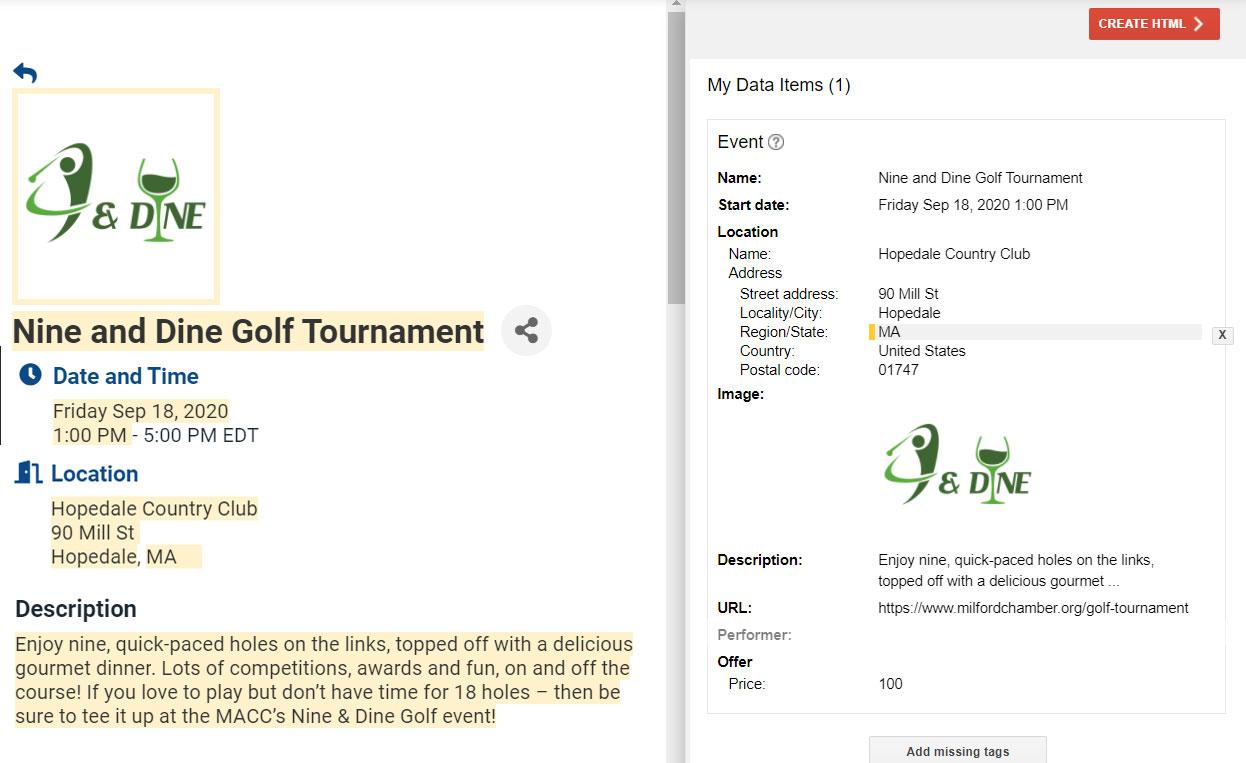
This free tool creates structured data markup by highlighting data on a live page and then tagging it.  The website type JSON-LD markups include the following types of items: Article, Events, Questions & Answer Page, Job Postings, Local Business, Products, Movies, Restaurants, Book Reviews, Software Applications, Datasets & TV Episodes. 

You can create schema for a webpage event with the following steps:

  1. Open the Structured Data Markup Helper.
  2. Select the Website tab and click Events
  3. Select the URL of the page you want to markup (e.g. https://business.milfordchamber.org/events/details/nine-and-dine-golf-tournament-1276)
  4. Select Start Tagging and highlight an item, then right-click to add it to My Data Items
  5. Add items not listed in the page by clicking Add Missing Tags.
  6. When you've finished tagging, click the Create HTML button on the upper right-hand side to generate the code. Specify the output format as JSON-LD (this is Googles’ recommended format).
  7. Copy and paste the generated code into the head section of your HTML page. Test your code by using Google Rich Results tester.

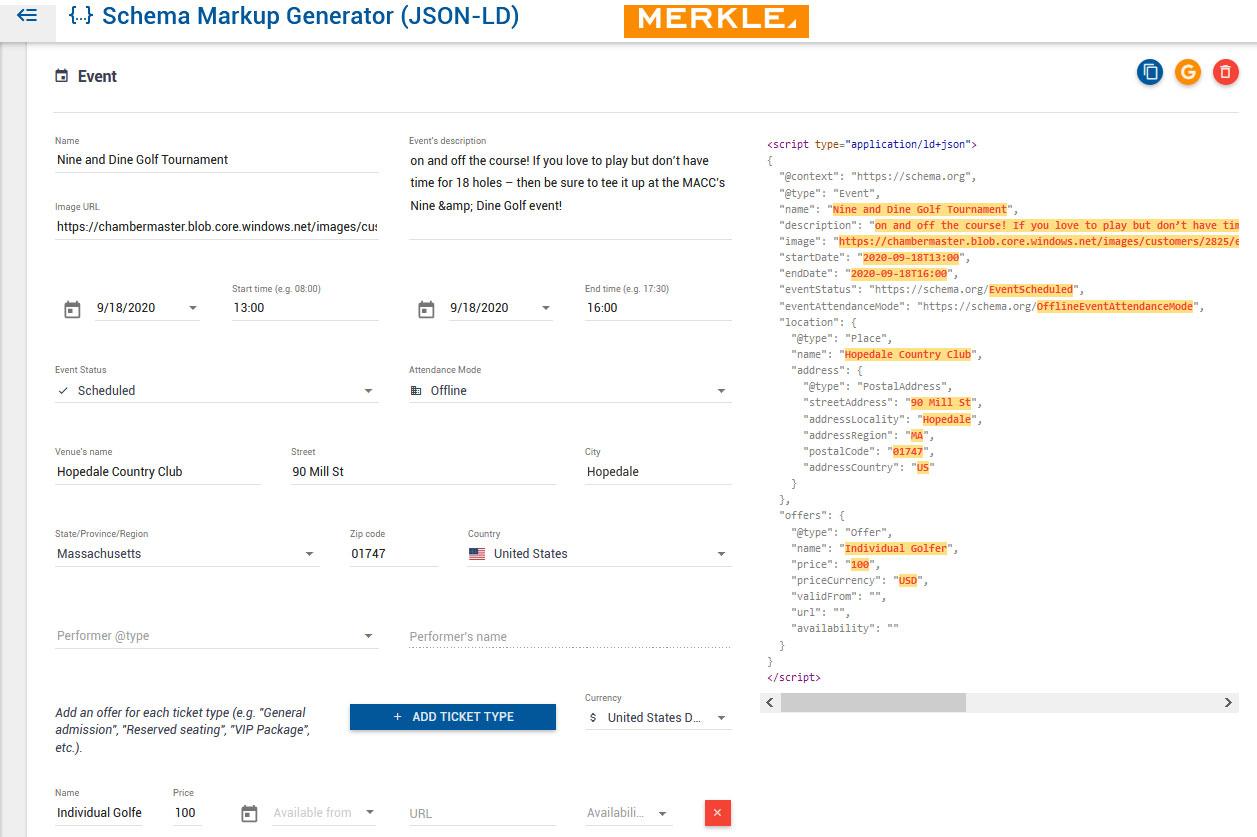
This is a free schema markup generator, which is used to create JSON-LD markups for the following items: Article, Breadcrumb, Event, FAQ Page, How-to, Job Posting, Local Business, Organization (Logo, Contacts, Social Profile), Person (Social Profile, Job Information), Product (Offer, Aggregate Rating, Reviews), Video, Website (Sitelinks Searchbox).

The procedure below also demonstrates how to create schema for a webpage event:

  1. Open Merkle Schema Markup Generator

  2. Click on
    Which Schema.org markup you would like to create? and make a selection.
  3. Fill in the Name, Description the URL of an existing page  (e.g. https://business.milfordchamber.org/events/details/nine-and-dine-golf-tournament-1276) and all other available fields.
  4. Copy and paste the generated code into the head section of your html page.  Test your code by using Google Rich Results tester.

This is a paid suite of tools that allows digital marketers to create and manage Schema markup without requiring them to be an expert in the Schema.org language or code generation. It is an advanced tool, but supports all types of enterprise-grade solutions and works with all websites and all content types. 


Schema App offers two different tools for authoring markup:


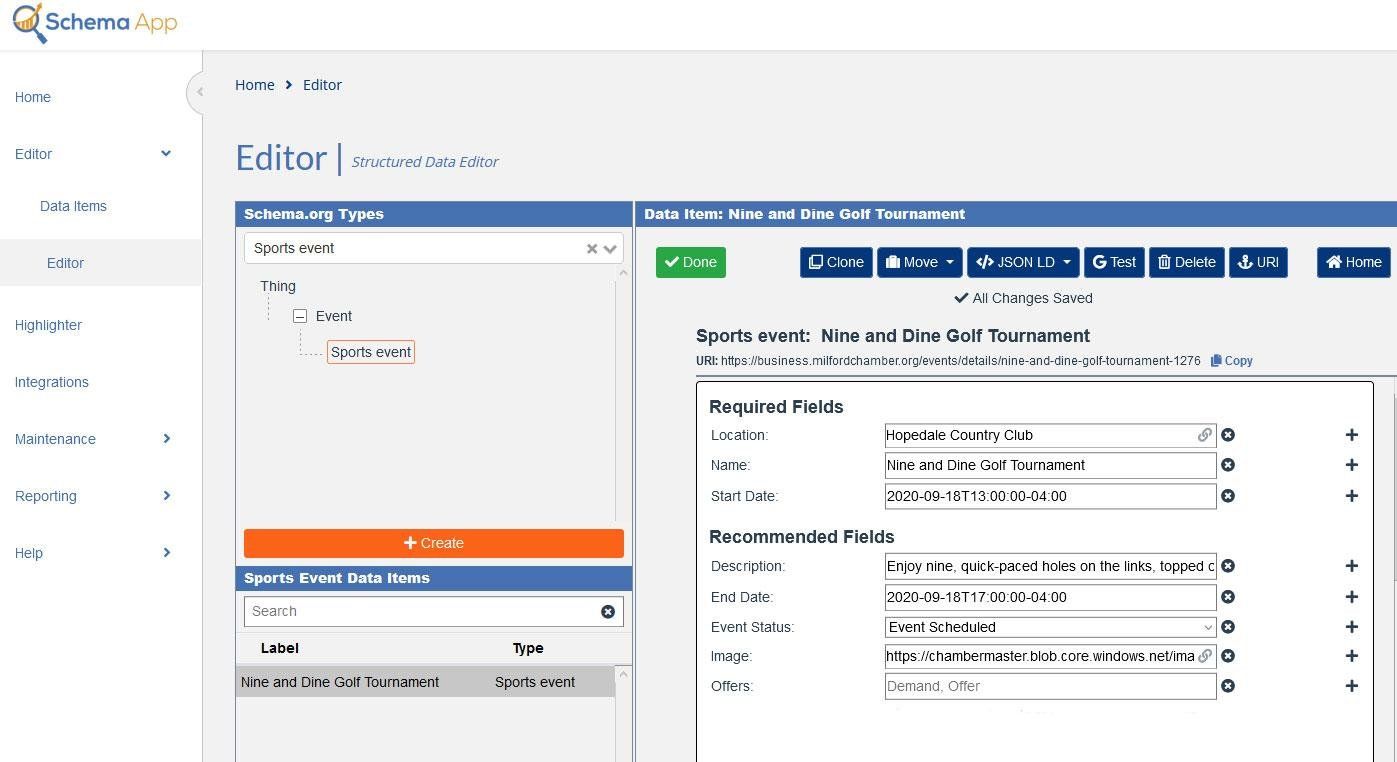
1. The Schema App Editor — This tool allows you to create custom markup through a form-like interface. It lists all required and recommended properties for a particular Schema.org class (or type) in order to be eligible for rich results, and lists all other properties available to a Schema.org class so that you may add more information to contextualize your data items. 

2. The Schema App Highlighter — This tool allows you to create a template for a particular Schema.org type (e.g. a Blog Posting) and deploy it across any number of pages that match the same structure. This means you can create schema markup at scale for hundreds or thousands of pages after only a few minutes of authoring the template.

For comparison sake, we are using the same event type structured data.


  1. Open the Schema App editor
  2. Create Data Item by supplying the name of the event and the URL (e.g. https://business.milfordchamber.org/events/details/nine-and-dine-golf-tournament-1276)
  3. Enter all required fields 
  4. Click the JSON-LD button, then copy and paste the generated code into the header section of your HTML page.
  5. Test your code by using Google Rich Results tester.

Examples of Structured Data


For the purpose of simplicity, we are going to use the Merkle Schema Markup Generator free tool and the JSON-LD schema type. Create each type of structured data by entering the type of schema and then add all necessary fields.

Local Business


<script type="application/ld+json">

{

"@context": "https://schema.org",

"@type": "LocalBusiness",

"name": "Local Business First",

"image": "https://lirp-cdn.multiscreensite.com/a998e953/dms3rep/multi/opt/local-business-first-logo1-240w.png",

"@id": "",

"url": "https://localbizfirst.com/",

"telephone": "508-344-7303",

"address": {

"@type": "PostalAddress",

"streetAddress": "258 Main Street, Suite 306",

"addressLocality": "Milford",

"addressRegion": "MA",

"postalCode": "01757",

"addressCountry": "US"

},

"geo": {

"@type": "GeoCoordinates",

"latitude": 42.138225,

"longitude": -71.521290

},

"openingHoursSpecification": {

"@type": "OpeningHoursSpecification",

"dayOfWeek": [

"Monday",

"Tuesday",

"Wednesday",

"Thursday",

"Friday"

],

"opens": "08:00",

"closes": "17:00"

},

"sameAs": [

"https://www.facebook.com/localbusiness1st",

"https://twitter.com/localbizfirst",

"https://www.instagram.com/localbizseofirst/",

"https://linkedin.com/in/olympia-caswell-bb28b017"

]

}

</script>

Blog Post


<script type = "application/ld+json"> 

{

 "@context": "https://schema.org",

 "@type": "BlogPosting",

 "mainEntityOfPage": {

  "@type": "WebPage",

  "@id": "https://localbizfirst.com/how-to-make-your-website-accessible"

 },

 "headline": "How to Make Your Website Accessible",

 "description": "If you are a government agency, have more than 15 employees, or your company operates for the public’ s benefit– you need to be compliant.Digital accessibility is a legal requirement and the lawsuits are on the rise.",

 "image": "https://irp-cdn.multiscreensite.com/a998e953/dms3rep/multi/make-your-website-accessible-for-everyone.jpg",

 "author": {

  "@type": "Person",

  "name": "Olympia Caswell"

 },

 "publisher": {

  "@type": "Organization",

  "name": "Local Business First",

  "logo": {

  "@type": "ImageObject",

  "url": "https://lirp-cdn.multiscreensite.com/a998e953/dms3rep/multi/opt/local-business-first-logo1-240w.png"

  }

 },

 "datePublished": "2020-06-04"

}

</script>

Event


<script type="application/ld+json">

{

"@context": "https://schema.org",

"@type": "Event",

"name": "Nine and Dine Golf Tournament",

"description": "Enjoy nine, quick-paced holes on the links, topped off with a delicious gourmet dinner.

Lots of competitions, awards and fun, on and off the course! If you love to play but don’t have time for 18

holes – then be sure to tee it up at the MACC’s Nine & Dine Golf event!",

"image":


"https://chambermaster.blob.core.windows.net/images/customers/2825/events/1276/200x200/eventbrite-

logo.png",


"startDate": "2020-09-18T12:00",

"endDate": "2020-09-18T17:00",

"eventStatus": "https://schema.org/EventScheduled",

"eventAttendanceMode": "https://schema.org/OfflineEventAttendanceMode",

"location": {

"@type": "Place",

"name": "Hopedale Country Club",

"address": {

"@type": "PostalAddress",

"streetAddress": "90 Mill St",

"addressLocality": "Hopedale",

"addressRegion": "MA",

"postalCode": "01747",

"addressCountry": "US"

}

},

"offers": [{

"@type": "Offer",

"name": "One Golfer",

"price": "100",

"priceCurrency": "USD",

"validFrom": "",

"url": "https://www.milfordchamber.org/golf-player-payment",

"availability": "https://schema.org/InStock"

}]

}

</script>


FAQ


<script type="application/ld+json">

{

"@context": "https://schema.org",

"@type": "FAQPage",

"mainEntity": [{

"@type": "Question",

"name": "What is the Milford Area Chamber of Commerce?",

"acceptedAnswer": {

"@type": "Answer",

"text": "The Milford Area Chamber of Commerce (MACC) is a business membership organization

serving ten local communities. The MACC means business. By fostering a pro-business climate, the

MACC helps to attract, retain and grow business while providing vital advocacy, engagement and

connections for its membership."

}

}]

}

</script>


Product


<script type="application/ld+json">

{

"@context": "https://schema.org/",

"@type": "Product",

"name": "Premium Package",

"image": "https://lirp-cdn.multiscreensite.com/a998e953/dms3rep/multi/opt/local-business-first-logo1-

240w.png",

"description": "10 page customized custom design. Additional pages $99 each AWS Hosting. Custom

Widgets / App Store. Marketing Tools. Monthly analytics (stats) reports. Integrated with your social

media. SEO Foundation. Content Writing. Keyword Research. Competitive Research. Mobile friendly /

Responsive. SSL certificate / Secure Site. Local Directory Submission.",

"brand": "Local Business First",

"offers": {

"@type": "Offer",

"url": "https://localbizfirst.com/pricing",

"priceCurrency": "USD",

"price": "4397"

}

}

</script>


Recipe


<script type="application/ld+json">

{

"@context": "https://schema.org/",

"@type": "Recipe",

"name": "GF Banana Peanut Butter Chocolate Chip Cake",

"image": "https://irp-cdn.multiscreensite.com/md/unsplash/dms3rep/multi/photo-1485474187873-

a541e1da7c51.jpg",

"description": "This cake is an updated version of a childhood favorite. My mom originally developed it

from a banana bread recipe. The original contained white flour, vegetable oil, white sugar, whole milk,

and Reese's peanut butter chips - which of course was delicious but not so healthy. In this version, I've

swapped these out for Pamela's Gluten Free Baking Mix, coconut oil, coconut sugar, almond milk and

organic chunky peanut butter. I hope you love it as much as I do.",

"keywords": "Gluten Free Banana Peanut Butter Chocolate Chip Cake",

"author": {

"@type": "Person",

"name": "Roann Karns"

},

"datePublished": "2019-12-10",

"prepTime": "PT10M",

"cookTime": "PT45M",

"totalTime": "PT55M",

"recipeCategory": "dessert",

"nutrition": {

"@type": "NutritionInformation",

"calories": ""

},

"recipeIngredient": [

"3 eggs",

"1/2 cup unrefined coconut oil (melted)",

"1/3 cup organic chunky peanut butter",

"2 Tbs lemon juice",

"1 cup coconut sugar",

"3 1/2 cups Pamela's Gluten Free Baking and Pancake Mix",

"3/4 cup unsweetened non-dairy milk (I use almond)",

"4 very ripe bananas (mashed)",

"1/2 -3/4 cup dark chocolate chips (I love Whole Foods 365 dark chocolate baking chunks)"

]

}

</script>


Video


<script type="application/ld+json">

{

"@context": "https://schema.org",

"@type": "VideoObject",

"name": "Personalization - Local Business First",

"description": "Local Business First - DIY Website - Personalization WATCH more DIY videos at

https://localbizfirst.com/diy-website...SUBSCRIBE to our channel here:

https://www.youtube.com/channel/UCiK_...",

"thumbnailUrl": "https://img.youtube.com/vi/KFUUgwnOGhA/0.jpg",

"uploadDate": "2020-05-01",

"duration": "PT6M5S",

"contentUrl": "https://localbizfirst.com/website-builder-videos",

"embedUrl": "https://youtu.be/KFUUgwnOGhA"

}

</script>


Summing Up

Schema is a fantastic tool that helps your website content show up in featured snippets, rich snippets, video carousels and knowledge panels. The results of implementing structured data in your page are not guaranteed, but it is likely that you will gain visibility in the search engines result pages (SERP) and also in the rich results.

Did you find this article interesting?


Thanks for the feedback!
By Shawn Davis April 1, 2026
Core Web Vitals aren't new, Google introduced them in 2020 and made them a ranking factor in 2021. But the questions keep coming, because the metrics keep changing and the stakes keep rising. Reddit's SEO communities were still debating their impact as recently as January 2026, and for good reason: most agencies still don't have a clear, repeatable way to measure, diagnose, and fix them for clients. This guide cuts through the noise. Here's what Core Web Vitals actually measure, what good scores look like today, and how to improve them—without needing a dedicated performance engineer on every project. What Core Web Vitals measure Google evaluates three user experience signals to determine whether a page feels fast, stable, and responsive: Largest Contentful Paint (LCP) measures how long it takes for the biggest visible element on a page — usually a hero image or headline — to load. Google considers anything under 2.5 seconds good. Above 4 seconds is poor. Interaction to Next Paint (INP) replaced First Input Delay (FID) in March 2024. Where FID measures the delay before a user's first click is registered, INP tracks the full responsiveness of every interaction across the page session. A good INP score is under 200 milliseconds. Cumulative Layout Shift (CLS) measures visual stability — how much page elements unexpectedly move while content loads. A score below 0.1 is good. Higher scores signal that images, ads, or embeds are pushing content around after load, which frustrates users and tanks conversions. These three metrics are a subset of Google's broader Page Experience signals, which also include HTTPS, safe browsing, and mobile usability. Core Web Vitals are the ones you can most directly control and improve. Why your clients' scores may still be poor Core Web Vitals scores vary dramatically by platform, hosting, and how a site was built. Some of the most common culprits agencies encounter: Heavy above-the-fold content . A homepage with an autoplay video, a full-width image slider, and a chat widget loading simultaneously will fail LCP every time. The browser has to resolve all of those resources before it can paint the largest element. Unstable image dimensions . When an image loads without defined width and height attributes, the browser doesn't reserve space for it. It renders the surrounding text, then jumps it down when the image appears. That jump is CLS. Third-party scripts blocking the main thread . Analytics pixels, ad tags, and live chat tools run on the browser's main thread. When they stack up, every click and tap has to wait in line — driving INP scores up. A single slow third-party script can push an otherwise clean site into "needs improvement" territory. Too many web fonts . Each font family and weight is a separate network request. A page loading four font files before rendering any text will fail LCP, especially on mobile connections. Unoptimized images . JPEGs and PNGs served at full resolution, without compression or modern formats like WebP or AVIF, add unnecessary weight to every page load. How to measure them accurately There are two types of Core Web Vitals data you should be looking at for every client: Lab data comes from tools like Google PageSpeed Insights, Lighthouse, and WebPageTest. It simulates page loads in controlled conditions. Lab data is useful for diagnosing specific issues and testing fixes before you deploy them. Field data (also called Real User Monitoring, or RUM) comes from actual users visiting the site. Google collects this through the Chrome User Experience Report (CrUX) and surfaces it in Search Console and PageSpeed Insights. Field data is what Google actually uses as a ranking signal — and it often looks worse than lab data because it reflects real-world device and connection variability. If your client's site has enough traffic, you'll see field data in Search Console under Core Web Vitals. This is your baseline. Lab data helps you understand why the scores are what they are. For clients with low traffic who don't have enough field data to appear in CrUX, you'll be working primarily with lab scores. Set that expectation early so clients understand that improvements may not immediately show up in Search Console. Practical fixes that move the needle Fix LCP: get the hero image loading first The single most effective LCP improvement is adding fetchpriority="high" to the hero image tag. This tells the browser to prioritize that resource over everything else. If you're using a background CSS image for the hero, switch it to anelement — background images aren't discoverable by the browser's preload scanner. Also check whether your hosting serves images through a CDN with caching. Edge delivery dramatically reduces the time-to-first-byte, which feeds directly into LCP. Fix CLS: define dimensions for every media element Every image, video, and ad slot on the page needs explicit width and height attributes in the HTML. If you're using responsive CSS, you can still define the aspect ratio with aspect-ratio in CSS while leaving the actual size fluid. The key is giving the browser enough information to reserve space before the asset loads. Avoid inserting content above existing content after page load. This is common with cookie banners, sticky headers that change height, and dynamically loaded ad units. If you need to show these, anchor them to fixed positions so they don't push content around. Fix INP: reduce what's competing for the main thread Audit third-party scripts and defer or remove anything that isn't essential. Tools like WebPageTest's waterfall view or Chrome DevTools Performance panel show you exactly which scripts are blocking the main thread and for how long. Load chat widgets, analytics, and ad tags asynchronously and after the page's critical path has resolved. For most clients, moving non-essential scripts to load after the DOMContentLoaded event is a meaningful INP improvement with no visible impact on the user experience. For websites with heavy JavaScript — particularly those built on frameworks with large client-side bundles — consider breaking up long tasks into smaller chunks using the browser's Scheduler API or simply splitting components so the main thread isn't locked for more than 50 milliseconds at a stretch. What platforms handle automatically One of the practical advantages of building on a platform optimized for performance is that many of these fixes are applied by default. Duda, for example, automatically serves WebP images, lazy loads below-the-fold content, minifies CSS, and uses efficient cache policies for static assets. As of May 2025, 82% of sites built on Duda pass all three Core Web Vitals metrics — the highest recorded pass rate among major website platforms. That baseline matters when you're managing dozens or hundreds of client sites. It means you're starting each project close to or at a passing score, rather than diagnosing and patching a broken foundation. How much do Core Web Vitals actually affect rankings? Honestly, they're a tiebreaker — not a primary signal. Google has been clear that content quality and relevance still dominate ranking decisions. A well-optimized site with thin, irrelevant content won't outrank a content-rich competitor just because its CLS is 0.05. What Core Web Vitals do affect is the user experience that supports those rankings. Pages with poor LCP scores have measurably higher bounce rates. Sites with high CLS lose users mid-session. Those behavioral signals — time on page, return visits, conversions — are things search engines can observe and incorporate. The practical argument for fixing Core Web Vitals isn't just "because Google said so." It's that faster, more stable pages convert better. Every second of LCP improvement can reduce bounce rates by 15–20% depending on the industry and device mix. For client sites that monetize through leads or eCommerce, that's a revenue argument, not just an SEO argument. A repeatable process for agencies Audit every new site before launch. Run PageSpeed Insights and record LCP, INP, and CLS scores for both mobile and desktop. Flag anything in the "needs improvement" or "poor" range before the client sees the live site. Check Search Console monthly for existing clients. The Core Web Vitals report surfaces issues as they appear in field data. Catching a regression early — before it compounds — is significantly easier than explaining a traffic drop after the fact. Document what you've improved. Clients rarely see Core Web Vitals scores on their own. A monthly one-page performance summary showing before/after scores builds credibility and makes your technical work visible. Prioritize mobile. Google uses mobile-first indexing, and field data shows that mobile CWV scores are almost always worse than desktop. If you only have time to optimize one version, do mobile first. Core Web Vitals aren't a one-time fix. Platforms change, new scripts get added, campaigns bring in new widgets. Build the audit into your workflow and treat it like any other ongoing deliverable, and you'll stay ahead of the issues before they affect your clients' rankings. Duda's platform is built with Core Web Vitals performance in mind. Explore how it handles image optimization, script management, and site speed automatically — so your team spends less time debugging and more time building.
By Ilana Brudo March 31, 2026
Vertical SaaS must transition from tools to an AI-powered Vertical Operating System (vOS). Learn to leverage context, end tech sprawl, and maximize retention.
By Shawn Davis March 27, 2026
Automate client management, instant site generation, and data synchronization with an API-driven website builder to create a scalable growth engine for your SaaS platform.
Show More

Latest posts