4 Incredible "Website Under Construction" Page Examples

November 7, 2020
0 minute read

If you’re in the process of redesigning or migrating a website, you probably don’t want site visitors showing up to a half-finished project or blank web page. After all, an unimpressive website experience is the fastest way to help your competitors acquire new customers. A better option is to simply display an interesting, informative and beautiful “website under construction” page.

Every business wants to build a strong rapport with customers and humanize their brand. A “website under construction” page provides you with the opportunity to accomplish both of these goals, even when your whole website is down. 

Therefore, it is crucial to have a “website under construction” landing page ready with a personalized message and alternative contact channels before you begin any migration or redesign your website. 

To help you acquire and retain customers even when a website is temporarily down, we’ve curated a list of five incredible “website under construction” page examples for inspiration.

But first, let’s talk about exactly what goes on a “website under construction” page.


Key Elements of a “Website Under Construction” Page

Somewhat obviously, a “website under construction” page’s main purpose is to let the visitor know they are at the correct web address, but the site is temporarily unavailable for a pre-planned reason. To ensure the visitor receives that message and can still ascertain some critical information about the business, there are certain elements that should be included on every “website under construction page.” Below are a few of them...

An Intriguing Design

A plain white background with a simple message that says “Coming Soon” would technically qualify as a “website under construction page,” but it would make for a pretty poor experience. Be sure to work your brand colors and logo into your temporary landing page and feel free to use icons or imagery that represent a redesign or construction project.

An Explanation of the Page & Business

You don’t need to go into as much detail as you would on an About Us page, but you should still include at least a short paragraph somewhere on your “website under construction” page that provides an overview of the business and why the website is currently unavailable to visitors. This will reinforce to site visitors that they are in fact in the right place and dealing with a professional business that takes its online presence seriously.

Contact Information & Lead Capture Form

Even though the full website isn’t available, you still want to give potential customers a way to reach out and contact you or stay informed for upcoming announcements about the business. This can be done by providing a phone number, email contact and links to social media profiles. You may also want to include a lead capture form that asks for the visitor’s email and signs them up for a newsletter. 

Protip: Keep your lead capture form as short as possible. It’s generally difficult to prompt site visitors to fill out long lead capture forms on any kind of web page, but it is especially hard on a “website under construction” page.


WHEN TO USE A “WEBSITE UNDER CONSTRUCTION” PAGE

Of course, there’s then knowing exactly when to use a “website under construction” page. As mentioned at the top, there are a couple of main reasons as to when you would use one, but there are a number of others that may require you to use a website builder and give your live site a bit of downtime. 


That’s why it’s so important to understand the key elements of them. Among the most common reasons you’d use a “website under construction” page are:

A Website Redesign or Brand New Site

First and foremost you may be initially designing or developing your site or giving your current site a total redesign. This is the most common usage, and can range from anything from implementing a new website template to a full scale start-to-finish design process.


If it’s the case of the former, where you already have a web presence but need a redesign, it’s so important to have a good landing page that take into account the tips offered above, while there are some great examples to inspire you as you read on.

A Rebrand

If you’re rebranding your website, whether it be off your own back or due to a company takeover, then you’re going to likely have to reskin or at least implement a number of changes on your site to reflect the change in branding.


These visual overhauls can be more time consuming than you think, so it’s important to get a placeholder sorted so as to not disrupt your business too much. There are many reasons why people go through a rebrand. It could be even as simple as a blogger wanting to monetize their site and you need to create more of an
ecommerce focused brand and site. Other reasons could be just wanting to freshen things up and modernize, and then there’s the buy-out situation which will almost certainly lead to website updates.

General Maintenance

Then there’s of course general maintenance too. You should always be keeping your fingers on the pulse when it comes to what your competitors have on their site, what pages are offering to rank best, and generally ensuring that your page falls in line with Google’s Core Web Vitals


If your site is going to be down for a little while while you
add widgets to your site or change up certain text or features, then it’s always a good idea to add a “website under construction” page, although you would tweak the copy to read you’re down for maintenance and offer up a time frame as to when you’ll be returning.


4 Incredible Examples of “Website Under Construction” Pages

A truly successful "website under construction" page will endow the visitor with a sense of what the brand behind the page is like — almost like a mini preview of what it will be like to interact with the fully completed website and the business that runs it.


Here are four pages that pull this off masterfully.

LandApart

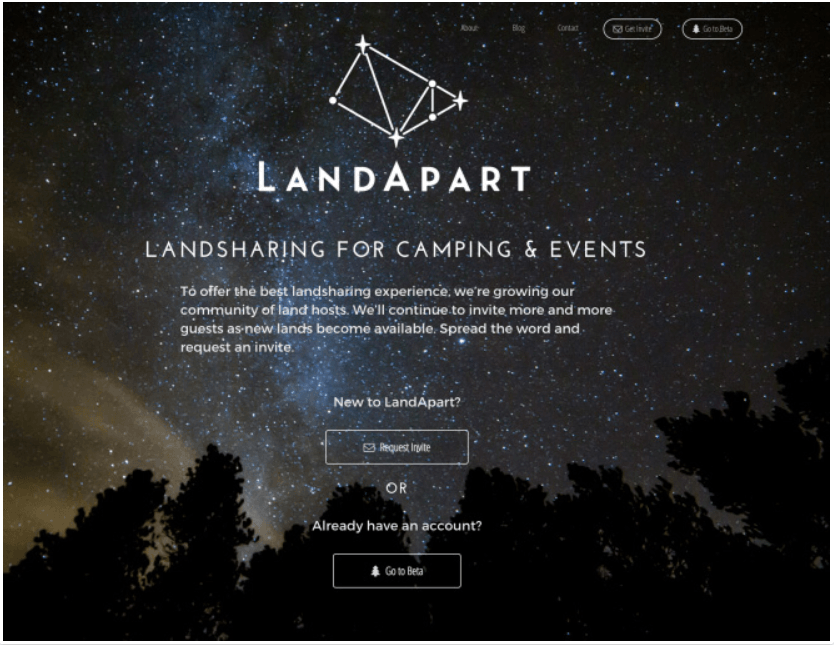
The LandApart “website under construction” page uses clever copy and an unusual CTA to position itself as an exclusive offering that visitors should aspire to wait for. The night sky background also provides helpful visual information to new visitors and ties into the business’s overarching camping theme.

LandApart has cleverly disguised its “website under construction” page as a registration page to capture leads. 

The text reads: 

To offer the best land sharing experience, we’re growing our community of land hosts. We’ll continue to invite more and more guests as new lands become available. Spread the word and request an invite.”  

Why we like it: The call-to-action (CTA) here says “Request Invite” making the company seem like an exclusive, invite-only club. LandApart wisely chose to go with a unique CTA instead of a generic “Join Now” or “Subscribe to Our Newsletter” approach. It works splendidly because visitors perceive the brand as more valuable prior to the product launch.

If you are in the travel and hospitality business and your operations have been impacted by COVID-19, this type of messaging and page layout will work really well until you get some clarity on when your operations can resume.


Flowdock

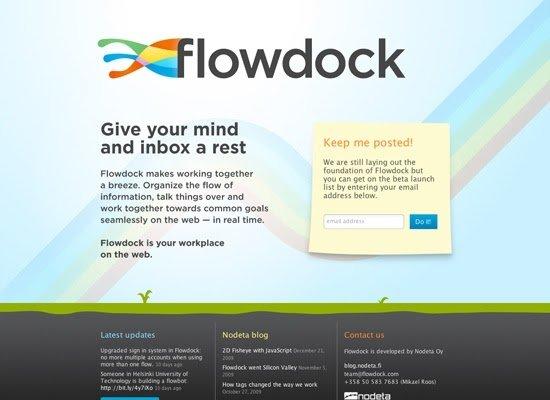
Flowdock uses a straightforward template with interesting copy that appeals to the logical side of visitors. It provides enough information about the product — a suite of collaboration tools — while informing potential visitors of its under-construction status. 

What we like: The page is visually appealing, drawing attention to the central part of the page with closely clustered copy and adjacent CTA. Again, the company leverages exclusivity by prompting visitors to sign up for a beta launch list. The large Flowdock banner placed right in the middle of a visitor’s line of sight also fosters a high degree of user recall.

Artmill

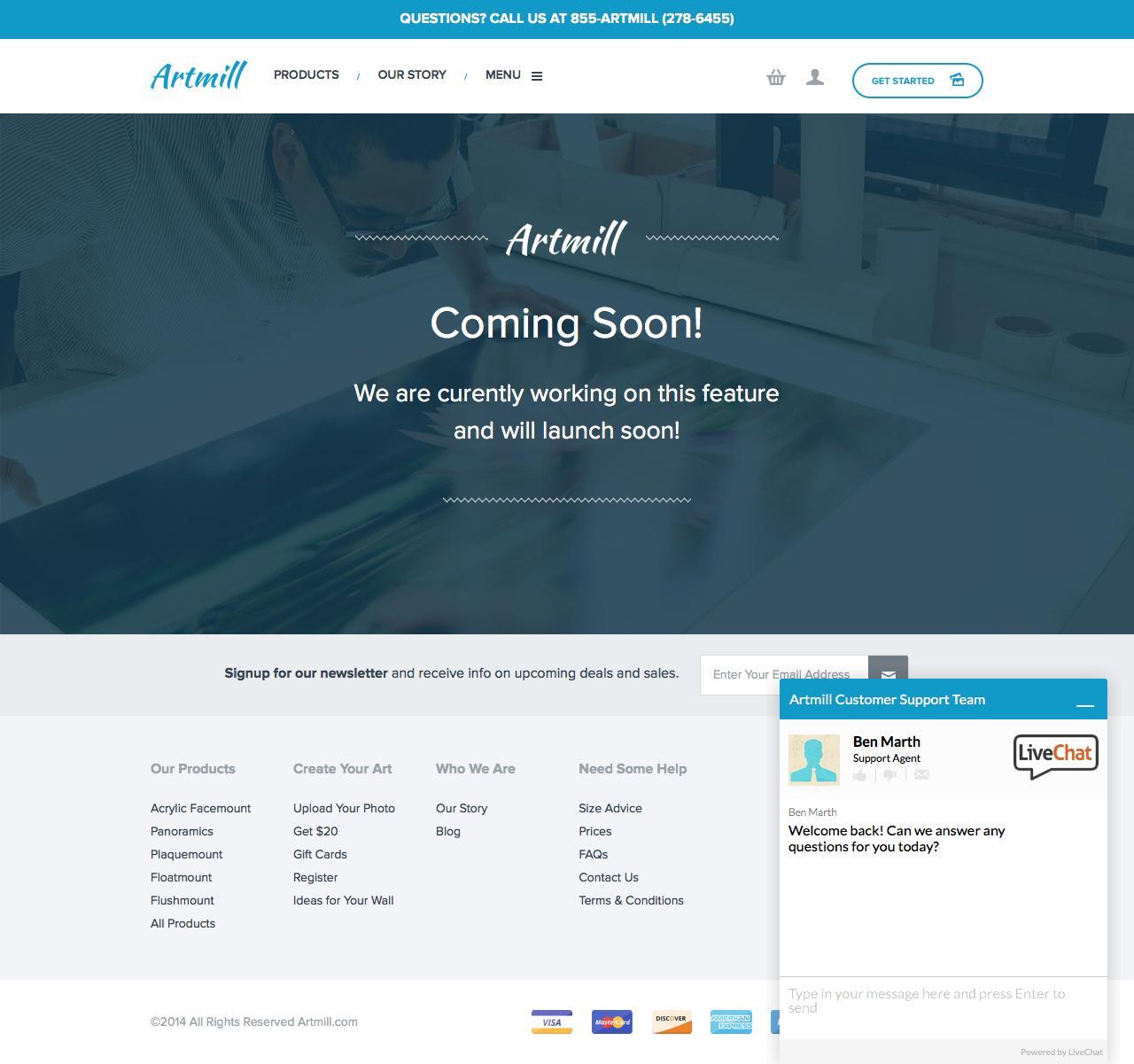
This website template prioritizes function over form. You won’t come across any exceptional visuals or CTAs here. But its simplicity works in its favor. 

What we like: The banner on top listing the phone number of the business makes it very easy for potential customers to get in touch. Also, the automatic chat option answers some frequently asked questions while delivering a personal touch. They also have a newsletter signup option which is great for capturing leads. Overall, this is an effective page that works well with the layout of its parent website and needed little customization.

WorkWeek

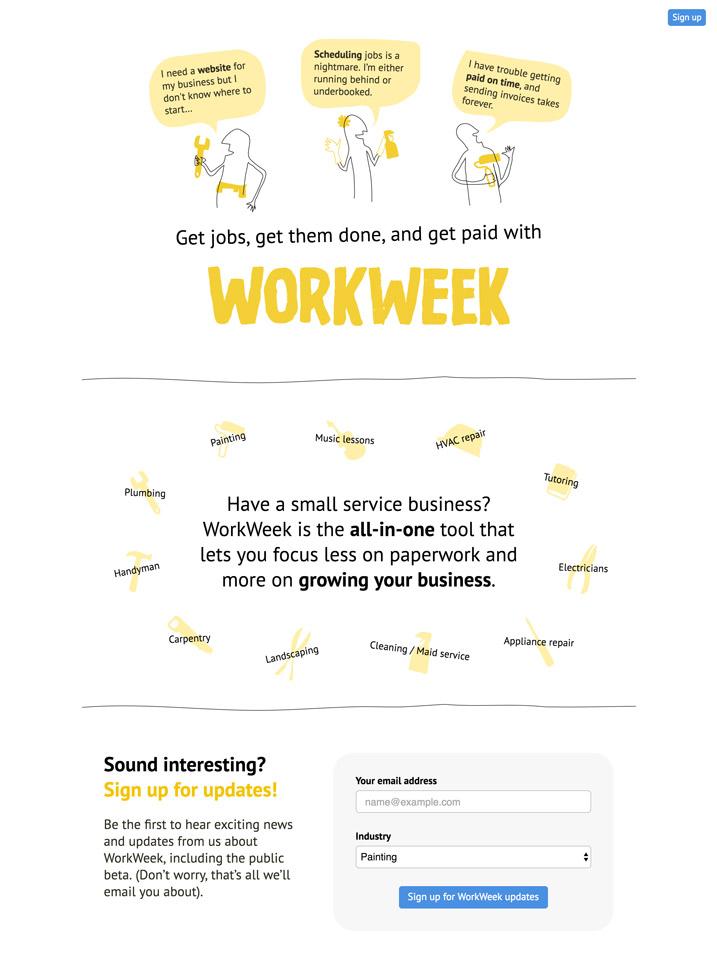
This “website under construction” page is very creative and uses sketches as the primary visual anchor. The comic-strip style visuals deliver a very engaging experience, particularly when combined with the sharply worded copy. It briefly lists the three most common problems small businesses face right at the top and highlights how the product acts as the ultimate solution for each of these and more. 

Why we like it: The crisp value proposition in the second section of the website provides visitors with a comprehensive understanding of the solution and how they can benefit from it. The CTA is also clutter-free and only asks visitors for their email address and industry. The dropdown industry menu is a clever lead segmentation touch that certainly helps WorkWeek segregate potential customers based on their intent.

Summing Up

The above examples obviously don't encompass the full breadth of "website under construction" page designs and user experiences; however, each one does provide a fantastic example of how you can make this type of page work for you. Just remember that what really sets a page like this apart is how the graphics, CTAs, interface, and copy come together to deliver an exceptional site experience to visitors. Focus on those elements and you're sure to create the ideal "website under construction" page for your business's site.



Did you find this article interesting?


Thanks for the feedback!
By Shawn Davis April 1, 2026
Core Web Vitals aren't new, Google introduced them in 2020 and made them a ranking factor in 2021. But the questions keep coming, because the metrics keep changing and the stakes keep rising. Reddit's SEO communities were still debating their impact as recently as January 2026, and for good reason: most agencies still don't have a clear, repeatable way to measure, diagnose, and fix them for clients. This guide cuts through the noise. Here's what Core Web Vitals actually measure, what good scores look like today, and how to improve them—without needing a dedicated performance engineer on every project. What Core Web Vitals measure Google evaluates three user experience signals to determine whether a page feels fast, stable, and responsive: Largest Contentful Paint (LCP) measures how long it takes for the biggest visible element on a page — usually a hero image or headline — to load. Google considers anything under 2.5 seconds good. Above 4 seconds is poor. Interaction to Next Paint (INP) replaced First Input Delay (FID) in March 2024. Where FID measures the delay before a user's first click is registered, INP tracks the full responsiveness of every interaction across the page session. A good INP score is under 200 milliseconds. Cumulative Layout Shift (CLS) measures visual stability — how much page elements unexpectedly move while content loads. A score below 0.1 is good. Higher scores signal that images, ads, or embeds are pushing content around after load, which frustrates users and tanks conversions. These three metrics are a subset of Google's broader Page Experience signals, which also include HTTPS, safe browsing, and mobile usability. Core Web Vitals are the ones you can most directly control and improve. Why your clients' scores may still be poor Core Web Vitals scores vary dramatically by platform, hosting, and how a site was built. Some of the most common culprits agencies encounter: Heavy above-the-fold content . A homepage with an autoplay video, a full-width image slider, and a chat widget loading simultaneously will fail LCP every time. The browser has to resolve all of those resources before it can paint the largest element. Unstable image dimensions . When an image loads without defined width and height attributes, the browser doesn't reserve space for it. It renders the surrounding text, then jumps it down when the image appears. That jump is CLS. Third-party scripts blocking the main thread . Analytics pixels, ad tags, and live chat tools run on the browser's main thread. When they stack up, every click and tap has to wait in line — driving INP scores up. A single slow third-party script can push an otherwise clean site into "needs improvement" territory. Too many web fonts . Each font family and weight is a separate network request. A page loading four font files before rendering any text will fail LCP, especially on mobile connections. Unoptimized images . JPEGs and PNGs served at full resolution, without compression or modern formats like WebP or AVIF, add unnecessary weight to every page load. How to measure them accurately There are two types of Core Web Vitals data you should be looking at for every client: Lab data comes from tools like Google PageSpeed Insights, Lighthouse, and WebPageTest. It simulates page loads in controlled conditions. Lab data is useful for diagnosing specific issues and testing fixes before you deploy them. Field data (also called Real User Monitoring, or RUM) comes from actual users visiting the site. Google collects this through the Chrome User Experience Report (CrUX) and surfaces it in Search Console and PageSpeed Insights. Field data is what Google actually uses as a ranking signal — and it often looks worse than lab data because it reflects real-world device and connection variability. If your client's site has enough traffic, you'll see field data in Search Console under Core Web Vitals. This is your baseline. Lab data helps you understand why the scores are what they are. For clients with low traffic who don't have enough field data to appear in CrUX, you'll be working primarily with lab scores. Set that expectation early so clients understand that improvements may not immediately show up in Search Console. Practical fixes that move the needle Fix LCP: get the hero image loading first The single most effective LCP improvement is adding fetchpriority="high" to the hero image tag. This tells the browser to prioritize that resource over everything else. If you're using a background CSS image for the hero, switch it to anelement — background images aren't discoverable by the browser's preload scanner. Also check whether your hosting serves images through a CDN with caching. Edge delivery dramatically reduces the time-to-first-byte, which feeds directly into LCP. Fix CLS: define dimensions for every media element Every image, video, and ad slot on the page needs explicit width and height attributes in the HTML. If you're using responsive CSS, you can still define the aspect ratio with aspect-ratio in CSS while leaving the actual size fluid. The key is giving the browser enough information to reserve space before the asset loads. Avoid inserting content above existing content after page load. This is common with cookie banners, sticky headers that change height, and dynamically loaded ad units. If you need to show these, anchor them to fixed positions so they don't push content around. Fix INP: reduce what's competing for the main thread Audit third-party scripts and defer or remove anything that isn't essential. Tools like WebPageTest's waterfall view or Chrome DevTools Performance panel show you exactly which scripts are blocking the main thread and for how long. Load chat widgets, analytics, and ad tags asynchronously and after the page's critical path has resolved. For most clients, moving non-essential scripts to load after the DOMContentLoaded event is a meaningful INP improvement with no visible impact on the user experience. For websites with heavy JavaScript — particularly those built on frameworks with large client-side bundles — consider breaking up long tasks into smaller chunks using the browser's Scheduler API or simply splitting components so the main thread isn't locked for more than 50 milliseconds at a stretch. What platforms handle automatically One of the practical advantages of building on a platform optimized for performance is that many of these fixes are applied by default. Duda, for example, automatically serves WebP images, lazy loads below-the-fold content, minifies CSS, and uses efficient cache policies for static assets. As of May 2025, 82% of sites built on Duda pass all three Core Web Vitals metrics — the highest recorded pass rate among major website platforms. That baseline matters when you're managing dozens or hundreds of client sites. It means you're starting each project close to or at a passing score, rather than diagnosing and patching a broken foundation. How much do Core Web Vitals actually affect rankings? Honestly, they're a tiebreaker — not a primary signal. Google has been clear that content quality and relevance still dominate ranking decisions. A well-optimized site with thin, irrelevant content won't outrank a content-rich competitor just because its CLS is 0.05. What Core Web Vitals do affect is the user experience that supports those rankings. Pages with poor LCP scores have measurably higher bounce rates. Sites with high CLS lose users mid-session. Those behavioral signals — time on page, return visits, conversions — are things search engines can observe and incorporate. The practical argument for fixing Core Web Vitals isn't just "because Google said so." It's that faster, more stable pages convert better. Every second of LCP improvement can reduce bounce rates by 15–20% depending on the industry and device mix. For client sites that monetize through leads or eCommerce, that's a revenue argument, not just an SEO argument. A repeatable process for agencies Audit every new site before launch. Run PageSpeed Insights and record LCP, INP, and CLS scores for both mobile and desktop. Flag anything in the "needs improvement" or "poor" range before the client sees the live site. Check Search Console monthly for existing clients. The Core Web Vitals report surfaces issues as they appear in field data. Catching a regression early — before it compounds — is significantly easier than explaining a traffic drop after the fact. Document what you've improved. Clients rarely see Core Web Vitals scores on their own. A monthly one-page performance summary showing before/after scores builds credibility and makes your technical work visible. Prioritize mobile. Google uses mobile-first indexing, and field data shows that mobile CWV scores are almost always worse than desktop. If you only have time to optimize one version, do mobile first. Core Web Vitals aren't a one-time fix. Platforms change, new scripts get added, campaigns bring in new widgets. Build the audit into your workflow and treat it like any other ongoing deliverable, and you'll stay ahead of the issues before they affect your clients' rankings. Duda's platform is built with Core Web Vitals performance in mind. Explore how it handles image optimization, script management, and site speed automatically — so your team spends less time debugging and more time building.
By Ilana Brudo March 31, 2026
Vertical SaaS must transition from tools to an AI-powered Vertical Operating System (vOS). Learn to leverage context, end tech sprawl, and maximize retention.
By Shawn Davis March 27, 2026
Automate client management, instant site generation, and data synchronization with an API-driven website builder to create a scalable growth engine for your SaaS platform.
Show More

Latest posts