Agency work has always involved adapting to new technology, but the pace of change over the past year has been difficult to ignore. AI tools are becoming part of everyday workflows, clients have more ways to produce their own websites and marketing materials, and the way people discover businesses online is changing. For agencies, these developments raise questions about how they work, which services they offer, and how they demonstrate the value of what they do.
Those questions were at the center of DudaCon 2026, where agency owners, SEO specialists, designers, and Duda's product team shared their experiences with AI, search, automation, and website development. Across the conversations, there was a common interest in how agencies could use new technology to improve their operations while continuing to deliver work that makes a measurable difference for clients.
Agencies are finding new ways to work with AI
AI has become a familiar part of agency workflows, particularly for tasks such as writing content, researching topics, generating images, and preparing first drafts. More recently, agencies have begun experimenting with AI agents that can work across different applications and complete longer sequences of tasks with less manual input.
During a discussion about the agentic agency, Duda's Director of Product Strategy, Russ Jeffery, described how these systems can connect tools and carry out work that would otherwise involve several separate steps. He shared an example from his own podcast production process, where he uses Claude Code to work with video files from three camera angles and editing tools on his computer. A process that previously took someone most of a day now takes approximately 30 minutes.
The discussion, which also featured Frederick Vallaeys, Co-founder and CEO of Optmyzr, and Sophie Brannon, Co-founder of StudioHawk US, explored how agencies are approaching this kind of automation. Much of the conversation focused on the practical considerations of introducing AI into existing workflows, including choosing suitable tasks, understanding the limitations of different tools, and deciding where human review is still needed.
Similar experiments are taking place in website and application development. Chris Wall, Owner of Strafford Media, shared how his agency has been using Duda Vibe to build client projects alongside tools for its own operations. One internal application, developed over roughly a week, was saving the agency approximately $11,000, according to Chris. The example showed how AI-assisted development can help agencies address operational problems that might previously have required more development time or outside resources.
The work still begins with understanding what needs to be built. During a Duda Vibe demonstration, Duda Product Manager Tal Levi explained how the quality of a project brief influences the resulting website or application. Business goals, brand guidelines, content, and technical requirements all help direct the AI's work. Agencies can move through parts of the development process more quickly, but they remain responsible for defining the project and evaluating what the tools produce.
The value of agency expertise is changing
As AI makes it easier to produce websites, content, and marketing materials, agencies are facing more competition for services that clients once had little choice but to outsource. A business owner can now generate a website or marketing plan using inexpensive tools, and some will decide that the result meets their needs.
This changing relationship between clients, agencies, and technology was a recurring subject at DudaCon. During a discussion featuring Corey Quinn, Advisor to Founder-Led Agencies, panelists explored how agencies can communicate their value when the work they deliver appears increasingly accessible to anyone with an AI subscription.
Part of the challenge lies in how clients evaluate the work. A website can be judged by its appearance and price, while the research, planning, and decisions behind it are less visible. Agencies with experience in a particular industry understand which services customers are searching for, what information they need before making contact, and how a website fits into a broader marketing strategy. That experience influences the finished product, even when some of the production work is automated.
Jason Swenk, Founder of Agency Mastery, offered a personal example of the limitations of working with AI outside your area of expertise. After connecting AI to his bookkeeping software, he initially thought he might be able to manage the process without an accountant. Over time, however, errors began appearing, and Jason lacked the accounting knowledge needed to identify and correct them reliably. His accountant understood the underlying work and could recognize when something was wrong.
Agencies encounter similar situations when clients attempt to manage their own SEO, advertising, or website projects. Access to the tools makes it possible to carry out more of the work independently, but it doesn't necessarily make the decisions any easier. The discussions at DudaCon returned frequently to the experience agencies bring to those decisions, particularly when clients need help choosing priorities, interpreting results, or adjusting their approach.
Search visibility is becoming harder to measure
Search has long been one of the more measurable parts of digital marketing. Agencies can track rankings, impressions, organic traffic, and conversions to understand how people find a business and what they do afterward. AI-generated search results are complicating that process because a recommendation can influence someone's decision without producing a direct website visit.
A person might ask ChatGPT to recommend a local service provider, see a business mentioned, and then search for that company by name. They might visit its Google Business Profile, call directly, or return to the business through another channel. The original recommendation may have played a role, but traditional analytics won't necessarily capture it.
SEO specialists discussing AI search at DudaCon described how they're adapting their reporting to account for these interactions. Alongside established SEO metrics, they're monitoring AI-generated mentions, brand searches, and other signals that may indicate increased visibility. The discussion also addressed the difficulty of interpreting those measurements, since appearing more frequently in AI-generated answers doesn't automatically translate into more inquiries or sales.
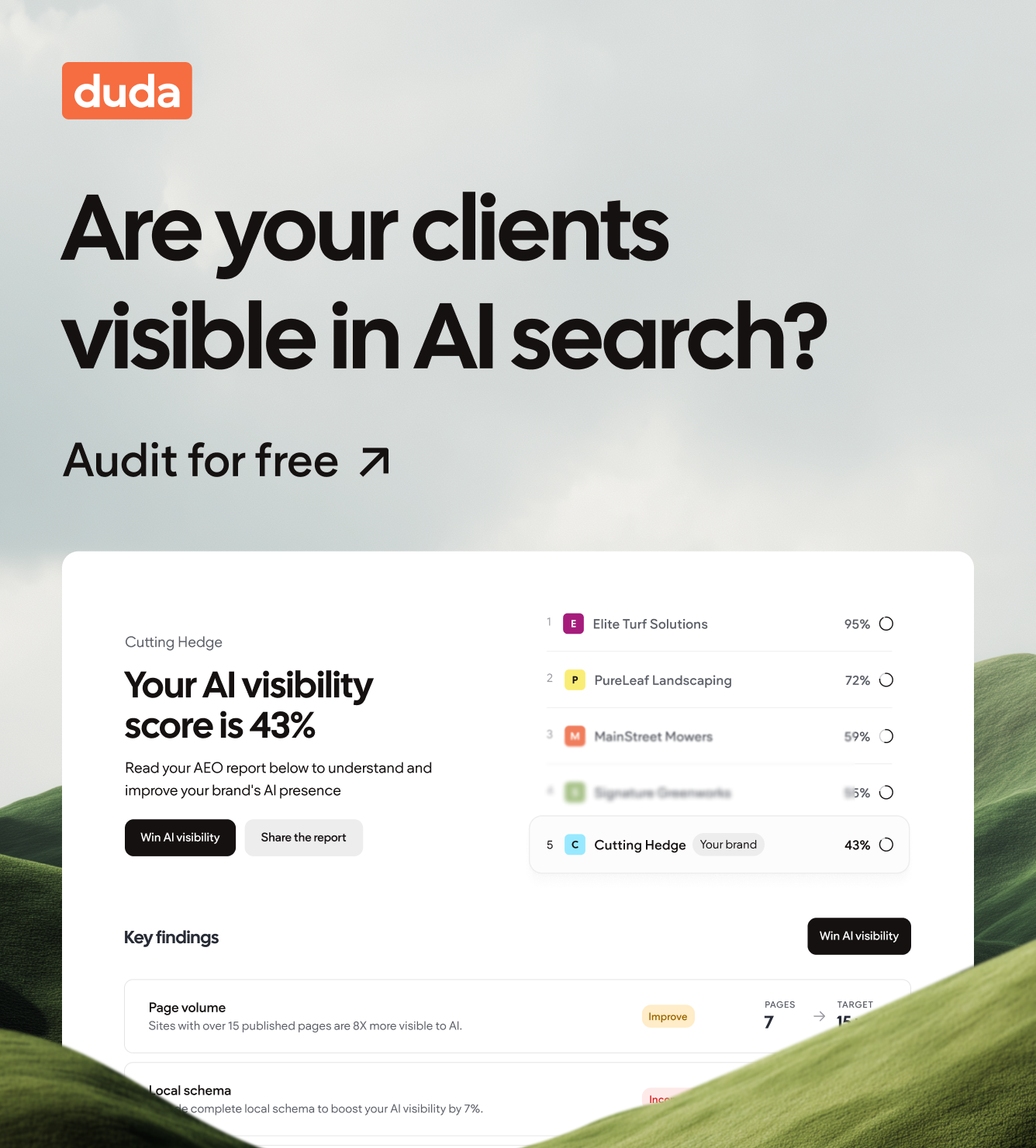
For agencies developing answer engine optimization (AEO) services, this creates a reporting challenge as well as a new area of work. Ruan M. Marinho, Founder of Develomark and CEO of SplashDash, described how his agency approaches AEO by first assessing where a client's business appears in AI-generated answers and how its visibility compares with competitors.
Using Duda's AI Visibility tools, agencies can monitor visibility scores, mentions, competitors, and selected prompts over time. Ruan and Naama Mizrahi, Senior Product Manager at Duda, discussed how prompt selection affects the usefulness of those reports. A broad query about a service category may produce interesting data, but a local business often needs to know how it performs for questions that include a specific service, problem, or location.
Ruan also demonstrated how his team uses the Duda MCP to work with information from Duda alongside Google Search Console, analytics, and call tracking. In one example, the team used customer call information and existing website content to identify a potential blog topic, prepare a draft, and make it available for review. The workflow brought together research and content production tasks that agencies often handle across several tools.
Attribution remains difficult, particularly when customers discover a business through one channel and make contact through another. Ruan described collecting information from calls and client conversations to better understand whether AI recommendations were contributing to new business. As agencies add AEO to their services, those efforts to connect visibility with business outcomes will be an important part of explaining the work to clients.
Agencies are paying closer attention to what happens after a lead arrives
Generating leads is a familiar agency service, but the work often ends when a prospective customer submits a form or calls the business. What happens afterward depends on the client's internal processes, which may be inconsistent or difficult to track.
Jason Swenk discussed this problem using an example involving dental practices that were losing prospective patients because calls went unanswered or inquiries received little follow-up. An agency could generate more leads for those practices, but improving the marketing campaign alone wouldn't address the missed appointments.
Research shared by Duda's product team suggests that many businesses have limited systems in place to manage incoming inquiries. In an analysis of more than 20,000 websites, nearly 90% had forms, but fewer than 6% had connected those forms to another system. Even among sites receiving more than 50 leads per month, fewer than 40% had integrations.
Without a reliable follow-up process, businesses may lose prospective customers who were interested enough to make contact. An inquiry can sit in an inbox until someone notices it, and a person who doesn't book immediately may never hear from the business again.
For agencies already managing websites and lead generation, helping clients improve these processes is a natural extension of their work. That might involve setting up automated responses, appointment reminders, or follow-up campaigns for people who have shown interest but haven't made a purchase. Agencies can also help clients understand which inquiries turn into customers and where prospective customers tend to drop out of the process.
During DudaCon, Jason and Liron Hilb Horev, Duda's Websites Product Leader, discussed how Marketing Automation could support a Pilates studio, using form submissions, follow-up emails, and promotional campaigns to guide prospective customers toward a purchase. The example illustrated how a website can support ongoing communication with customers after their first interaction.
Want to see what else is new? Duda co-founders Itai Sadan and Amir Glatt shared the latest additions to the platform during their keynote, including new ways to help agencies build, market, and manage websites. Catch up on the announcements in
Everything we announced at DudaCon '26.
Website design still depends on understanding how people make decisions
AI-assisted website development is making parts of the design and production process faster, but agencies still need to understand the people who will use the finished site. That includes the information visitors are looking for, the questions they need answered, and the experiences that might encourage them to make contact or complete a purchase.
A project shared by Icelandic agency Klick offered an example of how those considerations can influence a website's design. The agency worked with Torfhús Retreat, a luxury accommodation business, to increase direct bookings through its website. Because visitors travel to Iceland for different experiences depending on the season, Klick developed separate summer and winter presentations of the property and created a custom widget that lets visitors switch between them.
Someone planning a winter trip can explore the retreat through snowy landscapes and seasonal activities, while a summer visitor sees a different version of the same destination. The agency also aligned its advertising campaigns with the seasonal website experiences, creating a more consistent journey between an advertisement and the landing page.
According to Stefán Andrésson, Head of Web Design and Partner at Klick, direct bookings increased by 149% between 2023 and 2026. The website's conversion rate also rose from 0.2% to 0.6% between 2025 and 2026, a period that included the move to Editor 2.0 and the introduction of the seasonal toggle. The results reflect several changes to the site's design and marketing, but the seasonal experience provides a clear example of how an agency can adapt a website to the way customers plan their purchases.
Other examples from DudaCon explored how agencies can make websites easier to maintain while giving visitors more useful experiences. Klick demonstrated reusable staff-card widgets connected to Collections, allowing clients to update information without rebuilding page layouts. Duda's UI Design Lead and Product Designer, Anath Abenzour, also built a skincare studio landing page using repeaters, service information, reviews, and a multistep form that functioned as a skincare quiz.
The quiz asked visitors questions before guiding them toward relevant services, while also giving the business more context about each inquiry. Anath demonstrated how Copilot could help generate an FAQ section and how the resulting content could be reviewed and incorporated into the page.
These examples showed how agencies are combining familiar design principles with newer development tools. The technology can reduce the time spent building and maintaining a site, leaving more room to consider how visitors will use it and what the business wants them to do.
The agency's role is expanding beyond the website
The conversations at DudaCon reflected a broader change in the services agencies are being asked to provide. Clients still need websites, but they also need help appearing in traditional and AI-powered search results, managing inquiries, and understanding how their marketing contributes to business growth.
For some agencies, this means developing AEO services or taking on more responsibility for lead management and marketing automation. Others are experimenting with AI agents, building custom applications, or improving their internal processes so they can manage more work without expanding their teams at the same rate.
The examples shared throughout DudaCon showed agencies approaching these changes from different directions. Strafford Media was using AI-assisted development to solve an internal operational problem. Develomark was developing ways to deliver and report on AI visibility. Klick was refining the online booking experience for a hospitality client and measuring the results.
There are still plenty of unanswered questions, particularly around AI search, attribution, and how quickly clients will adopt new tools themselves. Agencies are working through those questions while continuing to manage the everyday demands of their businesses.
One of the best parts of DudaCon is hearing directly from the people doing this work. This year's speakers were generous with their experiences, sharing the approaches they've tested, the results they've seen, and the questions they're still working through. We've covered some of those conversations here, but there's plenty more worth hearing in full.
Whether you missed a session or want to revisit a particular discussion, you can
watch the DudaCon 2026 sessions on our YouTube playlist. We hope you find a few ideas to bring back to your own agency.