Being a freelance web designer or digital marketer can be both liberating and incredibly challenging. The ability to keep your own hours, pick what projects you take on, and be your own boss is often seen as the dream scenario by so many people. The flip side? You’re working without a net.
Billing? That’s your responsibility. Responding to client comments and questions? That’s on you. Keeping websites updated and secure? You’re on the hook. And the list doesn’t stop there. Everything from design aesthetics to SEO (do we dare even mention
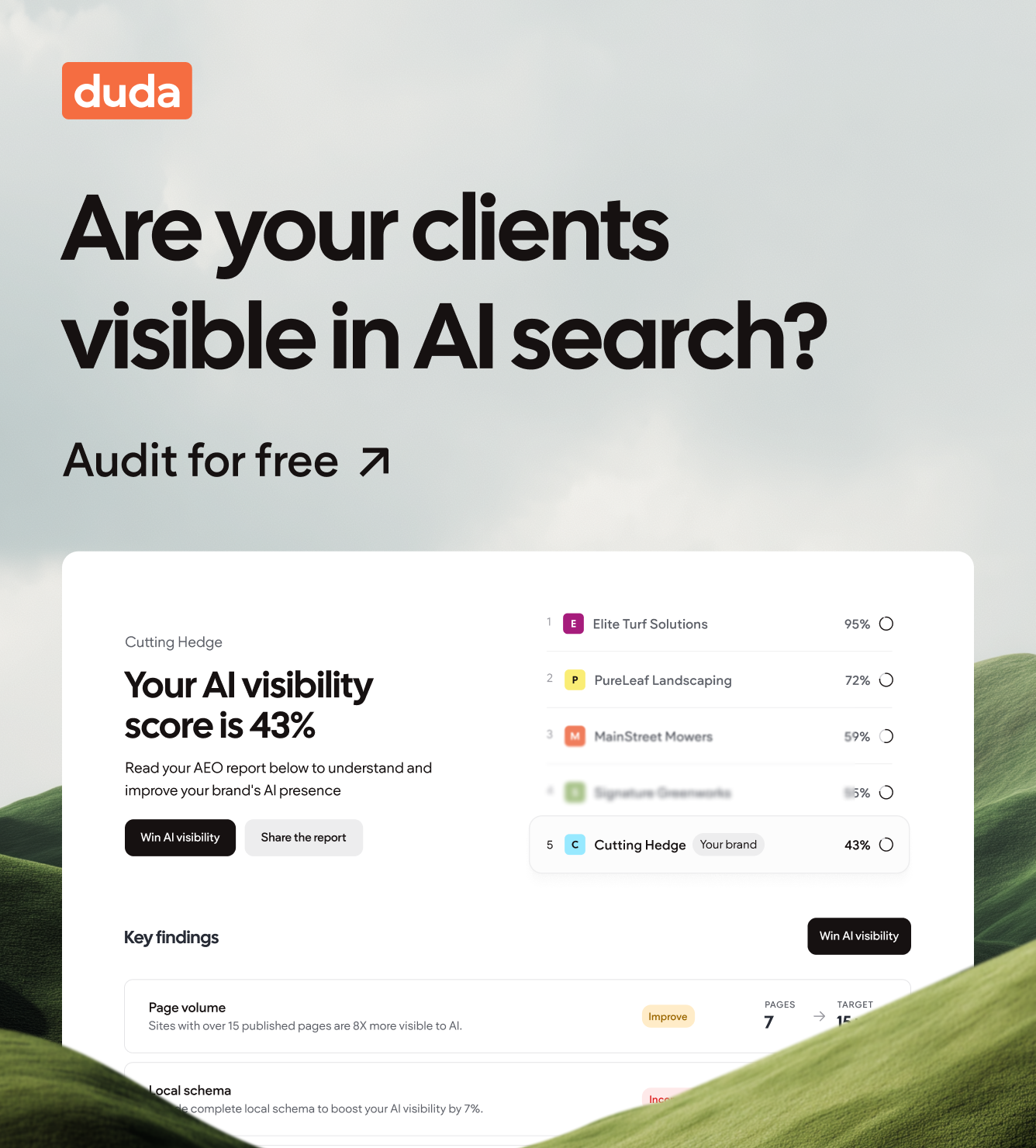
AI-powered search?) is in your hands, and yours alone. And this exciting, sometimes nerve-racking, way to work makes it absolutely essential that a freelancer selects the best possible tools to rely on.
For a wide variety of reasons, Duda is the perfect fit for this particular bill. When freelancers use the Duda platform to build websites for their clients, they’re not just getting a website builder—they’re getting an entire ecosystem of products and features that are specifically designed to help freelancers punch above their weight and scale up efficiently.
Let’s now take an in-depth look at what exactly makes Duda such an ideal site-building solution for freelance web designers and digital marketing professionals.
A web design platform with a purpose
If any web pro out there is wondering, “Is Duda good for freelancers?” The answer is a resounding, “yes”.
As mentioned earlier in this blog post, Duda is much more than a mere website builder that anyone can use to build sites. The team of developers and product designers behind the platform has been laser-focused on providing tools that are geared toward professional use for the better part of two decades now. The need to take a holistic approach in supporting the day-to-day operations of web pros who build sites for clients is basically their North Star.
The result of this obsession with offering ever-better tools to web designers and digital marketers is a platform that is flexible, extensible and packed to the gills with automation and AI-powered features that transform hours of busy work into streamlined workflows.
This sets Duda apart from site builders such as Wix and Squarespace that were primarily developed to help small business owners directly and treat agency- and freelance-specific features as afterthoughts. Independent web designers and digital marketers who choose to work with Duda can trust that their needs will always be put first above all other considerations, providing them with a significant advantage over competitors who choose to work with other tools.
Duda features designed for freelancers
Now that we’ve discussed the philosophy of Duda’s team and how they act to carry out their mission, let’s examine some of the individual products and features that are key to supporting and simplifying the life of a freelancer.
Comprehensive website security & easy maintenance
When a freelancer chooses to use a system like WordPress to build websites, they can expect to spend hours and hours maintaining their clients’ sites, updating plugins and ensuring there are no security vulnerabilities. This is often a key blocker that keeps web designers, developers and digital marketers from taking on new clients. If all of your time is spent trying to make sure existing client sites don’t go down or break, taking on new projects is pretty much impossible.
In contrast to platforms like WordPress, Duda provides an ecosystem that is maintained by a professional team of product managers and backend engineers. This ensures that all of the features included in a Duda website are always up to date and there are no security gaping security vulnerabilities to worry about or monitor for.
Additionally, every single website built on the Duda platform comes with
critical security features built-in by default and is hosted on a rock solid infrastructure.
The entire Duda platform, including both individual websites and the editor itself, is hosted on Amazon’s AWS platform, which guarantees a 99.5% uptime. The company also holds an active ISO 27001 certification and employs SAST, DAST, and SCA testing tools alongside cloud-infrastructure vulnerability scanners to ensure the integrity of the platform.
Based in Europe and worried about GDPR compliance? Don’t be. Duda supports Europe-only hosting in Frankfurt and advanced cookie compliance integrations, which ensures the sites you create adhere to the strictest privacy regulations.
Lastly, websites published on the platform include fully automated DDoS mitigation, free SSL certificates, and data encryption.
Together, these features save you hours and hours of time that would usually need to be spent babysitting your clients’ existing websites. Instead, you can dedicate that precious time to searching for net new clients and taking on fresh projects. Or learning a new hobby. Or going on vacation. We’re here to help you work more efficiently—what you do with the time saved is really up to you.
A 100% white label platform
Even if you’re an individual freelancer and don’t think of yourself as a digital agency owner, you still have your own brand, and it’s always a good idea to make sure that shines through for the clients you serve. And that’s why Duda enables you to place your own name, brand colors and logo on nearly every part of the Duda platform those clients might ever come into contact with. The website editor, support portal, automated email communications generated by the platform, billing pages, client login pages, website preview pages—all of it can be marked up with your branding so that clients only know you’re using Duda if you want them to.
It’s important to remember that working with a
white label website builder isn’t just all about successful self-promotion (though that certainly part of it). There’s a strategic angle as well.
The really important benefit is that you can enable customers to take an active role in managing their websites, without worrying that they will see the platform you’re working with and begin to wonder if they can create and maintain a website without you. Since Duda provides white label capabilities for every customer-facing part of its platform, you can bring clients into the site creation and management process at any point. From sharing a link to the editor so they can view and provide comments on early designs, to giving them access to manage the products in an eCommerce store, Duda makes it easy for you to work closely with clients, confidently. This both saves you time and looks impressive to customers at the same time (which, of course, strengthens custom loyalty).
Industry-leading AI capabilities
The AI revolution has produced an almost indescribable impact on the workflows and processes of basically everyone who relies on tech tools to serve their customers. Efficiency gains and capacity increases have grown by leaps and bounds since the release of LLMs like ChatGPT, Gemini, and Claude, and perhaps nobody has benefited more than solopreneurs and freelancers.
With support from the right kinds of AI tools, individuals can now accomplish what only yesterday took entire teams to do—and in a fraction of the time. And with Duda’s AI tools, the possibilities for web design freelancers are essentially limitless.
Here are just a few ways
Duda’s AI Stack helps freelancers work faster, expand their service offerings, and deliver high-quality results, without adding complexity to their workflow.
- Content creation and optimization — Generate page copy, headlines, product descriptions, and blogs directly within the editor. You can also refine tone, shorten or expand text, and adapt content to fit different client needs without leaving the platform.
- Built-in SEO assistance: AI helps generate titles, meta descriptions, alt text, and other essential SEO elements at scale, reducing manual work while improving consistency across sites.
- Page and section generation: Instead of starting from a blank canvas, AI can propose layouts and sections based on the business type, giving you a strong foundation you can customize.
- Smarter client onboarding: AI-assisted content collection forms help gather key business information upfront, minimizing delays and cutting down on endless revision cycles.
- Conversational workflows and automation: With AI-powered commands, you can create pages, publish content, or update site elements using natural language, streamlining repetitive tasks.
With these tools in hand, freelancers can operate much more like full fledged agencies, capture more customers and provide more value than most have probably ever thought possible.
Fully integrated client billing
Designing, developing and maintaining websites for clients are all pointless actions unless you can collect payment for your work. But keeping track of which customer owes what can be quite a headache for a freelancer with a growing client list. Nobody wants to spend time sending out invoices and chasing down payments for their services.
So to help streamline payment collection, Duda offers fully integrated, white label
client billing tools. You can automate invoicing, get paid for both one-time projects or ongoing subscriptions, and even trigger site publishing (or unpublishing) based on payment status—entirely inside the Duda platform.
Duda’s integrated billing system allows you to customize communications regarding payments, and integrates with Stripe for secure, local currency payments via major credit and debit cards.
Notably, the benefits of having your billing tools integrated with the rest of the Duda platform don’t just extend to you as a freelancer. Clients enjoy a seamless, white-labeled experience, accessing their sites and billing in one place under your brand.
A dashboard tailored for multi-site management
One of the most common challenges faced by freelancers is the need to work with separate tools and juggle multiple logins for each one of their clients’ individual projects. Duda removes this problem entirely by providing freelancers with a centralized dashboard where you can view, manage, and organize all your sites in one place.
However, the dashboard is really only the tip of the iceberg when it comes to Duda features that make it easy for freelancers to manage a large quantity of websites.
Other key Duda features that help freelancers with
multi-site management include:
- Granular roles and permissions: Duda gives you complete control over what your clients can and can’t do on their websites. You can assign specific levels of access to customers so they can only make the edits and changes you want them to.
- Site-specific invites: Clients are invited to collaborate on individual sites, so they only see their own projects. This keeps you from having to worry about the wrong customer getting access to the wrong website.
- Reusable templates & bulk duplication: You can save custom templates and duplicate existing sites in bulk to launch new projects faster and maintain consistency across your portfolio.
- API-controllable governance: Duda's API enables you to automate site management tasks, from assigning permissions to duplicating sites, making it easy to scale and streamline operations as your client list grows.
Final thoughts
Freelance web design work comes with real freedom, but also real responsibilities. When everything from site security to client communication falls on your shoulders, the tools you choose matter a lot.
Duda stands out because it was built with those realities in mind. It combines hosting, security, client access, billing, AI assistance, and site management into a single platform that actually holds up as your workload grows. Instead of patching together plugins and third-party services, freelancers can rely on one system that is stable, professional, and designed for client work.
For web designers and digital marketers who want to spend less time maintaining websites and more time delivering results, Duda offers a practical foundation to build and scale a freelance business with confidence.